
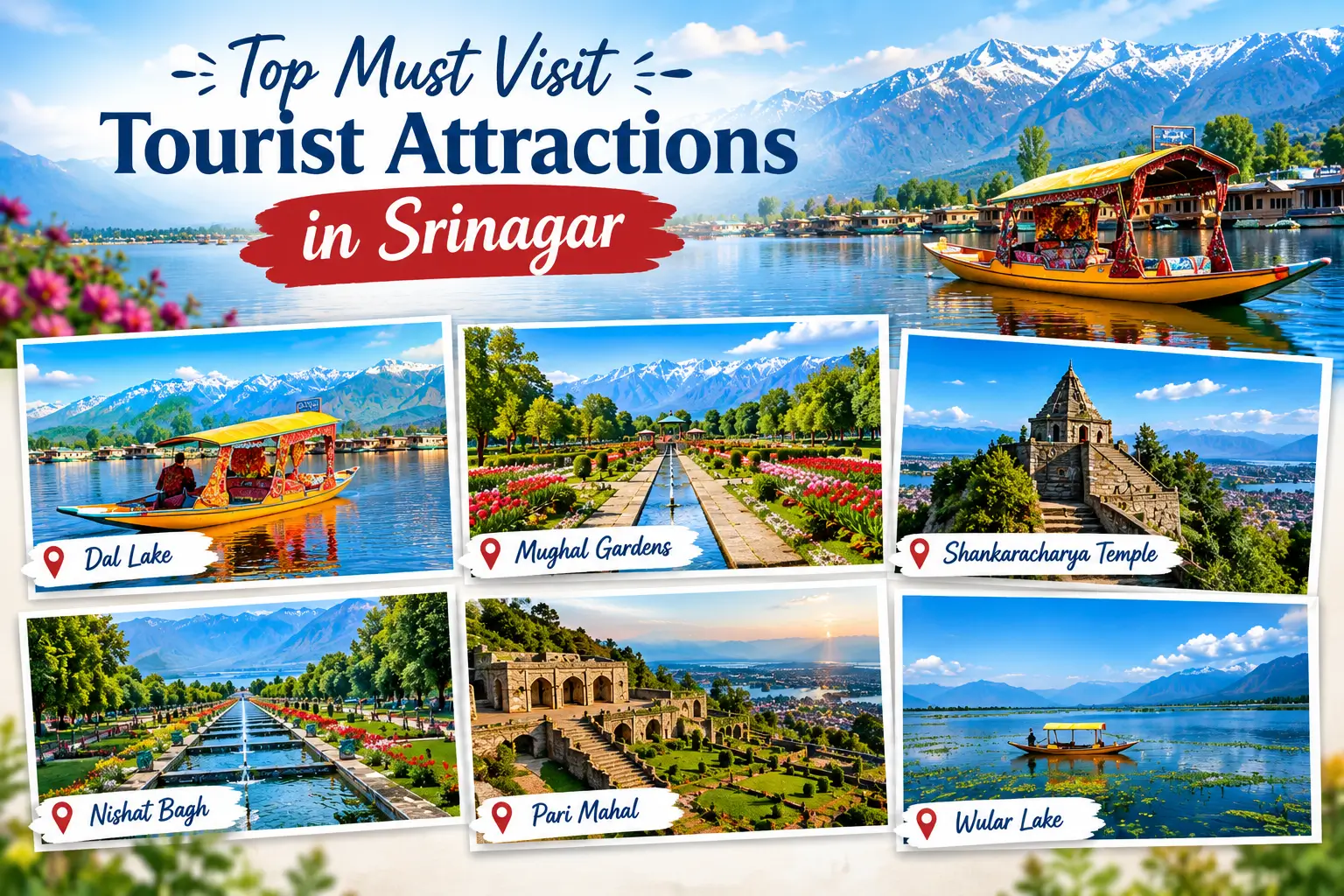
Top Must Visit Tourist Attractions in Srinagar
Top Tourist Attractions to Visit in Srinagar
Srinagar, the summer capital of Jammu and Kashmir, is one of India’s most distinctive mountain destinations. Set around the waters of Dal Lake and surrounded by the Zabarwan and Pir Panjal ranges, the city combines lakes, Mughal gardens, historic shrines, temples, old-city architecture and traditional Kashmiri culture.
For tourists visiting Kashmir, Srinagar is more than a gateway to destinations such as Gulmarg, Pahalgam and Sonamarg. The city itself deserves at least two to three days to experience its major attractions at a comfortable pace.
Enquiry Form
From a peaceful shikara ride on Dal Lake and walks through the historic Mughal gardens to panoramic views from Shankaracharya Hill and the heritage lanes of the Old City, Srinagar offers attractions for couples, families, photographers, history enthusiasts and visitors interested in Kashmir’s culture.
The Srinagar District Administration lists Dal Lake, Nigeen Lake, Chashma Shahi, Nishat Bagh, Shalimar Bagh, Pari Mahal, Hari Parbat, Dachigam National Park, Harwan, Tulip Garden and the Shankaracharya Temple among the city’s notable places of interest.
Dal Lake
No visit to Srinagar is complete without spending time at Dal Lake. Often described as the “Jewel in the Crown of Kashmir,” the lake is closely associated with Srinagar’s identity, traditional houseboats, shikaras and floating gardens.
A shikara ride is one of the most popular things to do in Srinagar. Visitors can enjoy views of the surrounding mountains, Mughal gardens and lakeside settlements while experiencing the traditional lifestyle associated with Kashmir’s waterways.
Dal Lake covers approximately 18 square kilometres and includes floating gardens, waterways and several basins. Lotus flowers can be seen in parts of the lake during the summer flowering season.
Best experience: Take a shikara ride during the early morning or around sunset.
Nishat Bagh
Nishat Bagh is among the most beautiful Mughal gardens in Srinagar. Located on the eastern side of Dal Lake, the garden combines terraced landscaping, fountains, water channels, flower beds and impressive views across the lake.
Built in 1633 by Asif Khan, the brother of Nur Jahan, Nishat Bagh is the second-largest Mughal garden in Kashmir. Its elevated terraces provide particularly attractive views of Dal Lake and the surrounding mountains.
The garden is an excellent place for a leisurely walk and photography, especially when flowers are in bloom.
Best experience: Visit in spring and summer when the garden is at its most colourful.
Shalimar Bagh
Shalimar Bagh is another major Mughal attraction on the shores of Dal Lake. Created during the reign of Emperor Jahangir, the garden represents the Mughal fascination with Kashmir’s landscapes and the idea of creating an earthly paradise.
Its landscaped terraces, fountains, water channels, mature trees and historic architecture make it one of the most important heritage attractions in Srinagar. Shalimar Bagh is also the largest of Srinagar’s principal Mughal gardens.
Tourists visiting Nishat Bagh can easily include Shalimar Bagh in the same sightseeing circuit.
Best experience: Combine Shalimar Bagh, Nishat Bagh and a Dal Lake shikara ride in one day.
Chashme Shahi
Chashme Shahi Garden
Chashme Shahi, meaning the “Royal Spring,” is the smallest of the principal Mughal gardens of Srinagar but is particularly attractive because of its natural spring and hillside setting.
The garden was constructed in 1632 by Ali Mardan Khan under the orders of Emperor Shah Jahan for Prince Dara Shikoh. Built around a natural spring, Chashme Shahi features terraces, fountains, water channels and scenic views towards Dal Lake.
The garden is especially pleasant between spring and autumn, with April to October generally considered a favourable period for visiting.
Best experience: Visit Chashme Shahi along with Pari Mahal because the two attractions are very close to each other.
Pari Mahal
Perched high on the Zabarwan range, Pari Mahal is one of the most photogenic historic attractions in Srinagar. Its name is commonly translated as “Palace of Fairies.”
The seven-terraced structure was built in the mid-17th century by Dara Shikoh, the eldest son of Shah Jahan. Historical accounts associate the site with learning, astronomy and an observatory, while its elevated position provides expansive views over Srinagar and Dal Lake.
Pari Mahal is particularly popular around sunset when the city, lake and surrounding mountains create a striking landscape.
Best experience: Visit in the late afternoon and stay for sunset if local access conditions permit.
Shankaracharya Temple
The Shankaracharya Temple stands on Shankaracharya Hill and is one of Srinagar’s most prominent religious and viewpoint attractions.
Dedicated to Lord Shiva, the temple occupies an elevated position overlooking the city and Dal Lake. Its location makes it one of the best places to appreciate the geography of Srinagar from above.
The climb and access arrangements mean visitors should allow sufficient time and follow the site’s security and visitor instructions.
Best experience: Visit earlier in the day for clear panoramic views.
Important: Dress respectfully and follow temple rules. Photography restrictions may apply in sensitive areas.
Hazratbal Shrine
Hazratbal Shrine is one of the most revered Islamic sites in Srinagar. Located on the northern shore of Dal Lake, the white-marble shrine has major religious importance and is associated with a sacred relic believed by devotees to be a hair of Prophet Muhammad.
The shrine also occupies a picturesque location beside the lake, with mountain views creating a memorable setting. Incredible India identifies Hazratbal among Srinagar’s important cultural and religious attractions.
Visitors should dress modestly and maintain the decorum expected at an active place of worship.
Best experience: Combine Hazratbal with Nigeen Lake and other northern Srinagar attractions.
Nigeen Lake
Nigeen Lake offers a quieter alternative to the busier parts of Dal Lake. Surrounded by trees and mountain scenery, it is known for its peaceful atmosphere, houseboats and water-based activities.
Kashmir Tourism describes Nigeen as a crescent-shaped lake and highlights activities such as canoeing, sailing and water sports.
For visitors who prefer a slower pace, Nigeen Lake can be an excellent addition to a Srinagar itinerary.
Best experience: Enjoy the lake in the morning or stay in a traditional houseboat for a more relaxed experience.
Old Srinagar and Jamia Masjid
Jamia Masjid Srinagar
The historic Old City provides a different experience from Srinagar’s lakes and gardens. Its narrow lanes, traditional buildings, markets and religious landmarks offer an opportunity to understand the city’s cultural heritage.
Jamia Masjid in Nowhatta is one of the area’s most important architectural landmarks. The mosque is particularly notable for its traditional wooden construction and large courtyard.
Incredible India also highlights Srinagar’s Old City, Jamia Masjid, Shah Hamdan shrine and traditional markets as important parts of the city’s cultural landscape.
Best experience: Explore the area with a local guide if you want greater historical and cultural context.
Hari Parbat
Hari Parbat is a prominent hill overlooking Srinagar and an important part of the city’s religious and historical landscape. The hill and its surrounding area contain landmarks associated with different faith traditions, making it significant to Srinagar’s multicultural heritage.
The Srinagar District Administration lists Hari Parbat among the city’s notable places of interest.
Because access arrangements around religious and protected sites can vary, visitors should check current local instructions before travelling.
Indira Gandhi Memorial Tulip Garden
The Indira Gandhi Memorial Tulip Garden is one of Srinagar’s most seasonal attractions. Located on the foothills of the Zabarwan range overlooking Dal Lake, it becomes particularly popular during the annual tulip flowering season.
For tourists visiting Kashmir in spring, the garden can be one of the most visually impressive places in Srinagar. The experience is strongly seasonal, so visitors should check the current flowering period and opening information before visiting.
The garden is officially listed among Srinagar’s places of interest by the district administration.
Best experience: Visit during the tulip blooming season and combine it with Chashme Shahi and Pari Mahal.
Dachigam National Park
For visitors interested in wildlife and Himalayan landscapes, Dachigam National Park is an important excursion from Srinagar.
The park is particularly known for the endangered Hangul, or Kashmir stag. Kashmir Tourism places Dachigam approximately 22 km from Srinagar and notes its diverse Himalayan habitat and wildlife.
A visit to Dachigam is different from conventional Srinagar sightseeing because wildlife sightings are naturally unpredictable. Visitors should therefore treat the experience as a nature excursion rather than expecting guaranteed animal sightings.
Best for: Wildlife enthusiasts, photographers and nature lovers.
Harwan Garden
Harwan is another scenic attraction on the outskirts of Srinagar and is associated with landscaped gardens, water features and the surrounding Himalayan environment.
The Srinagar District Administration includes Harwan among the city’s places of interest.
Its relatively peaceful setting makes it suitable for tourists looking to spend time away from the busiest sightseeing areas.
Badamwari Garden
Badamwari is another attractive green space in Srinagar and is particularly associated with almond blossoms during the spring season.
Located in the historic area around Hari Parbat, the garden provides a seasonal attraction for visitors interested in flowers, photography and Srinagar’s heritage landscape.
Badamwari is included in the official list of Srinagar’s places of interest.
Srinagar’s Traditional Markets and Kashmiri Handicrafts
A Srinagar sightseeing itinerary should not end with monuments and gardens. The city’s markets are an important part of the visitor experience.
Tourists can explore shops and bazaars selling Kashmiri handicrafts, Pashmina products, carpets, papier-mâché articles, spices, dry fruits and other locally associated products. Incredible India specifically highlights the Old City’s bazaars and Kashmiri handicrafts as part of Srinagar’s cultural appeal.
When purchasing expensive handicrafts or products represented as genuine Pashmina or handmade carpets, buyers should ask about authenticity, material and certification rather than relying solely on verbal claims.
How Many Days Are Enough for Srinagar Sightseeing?
A 2-day Srinagar itinerary can cover the major city attractions, including Dal Lake, Nishat Bagh, Shalimar Bagh, Chashme Shahi, Pari Mahal and Shankaracharya Temple.
With 3 days in Srinagar, tourists can explore the Old City, Hazratbal, Nigeen Lake, Hari Parbat and seasonal attractions at a more relaxed pace.
If you have 4 or more days, Srinagar can also be used as a base for excursions to destinations such as Dachigam and other parts of the Kashmir Valley.
A World to Explore
Plan Your Kashmir Trip — Guides & Packages
Handpicked reads and ready-to-book itineraries from Travfolks Holidays to help you shape the perfect Kashmir holiday.
- Travel Guide Kashmir Tourist Places Srinagar, Gulmarg, Pahalgam & more
- Travel Guide Things to Do in Kashmir Shikara rides, gondola & trekking
- Travel Guide Kashmir Tour Packages All Kashmir itineraries in one place
- Tour Package Srinagar Pahalgam Gulmarg 6N/7D The complete valley circuit
- Tour Package Kashmir with Vaishno Devi 6N/7D Valley beauty with holy darshan
- Tour Package Ladakh Tour 6 Nights 7 Days High passes, Pangong & monasteries
Frequently Asked Questions About Tourist Attractions in Srinagar
The top attractions include Dal Lake, Nishat Bagh, Shalimar Bagh, Chashme Shahi, Pari Mahal, Shankaracharya Temple, Hazratbal Shrine, Nigeen Lake, the Old City, Hari Parbat and the Tulip Garden. Srinagar also provides access to Dachigam National Park and other attractions around the Kashmir Valley.
Two days are enough to cover the major attractions in Srinagar, including Dal Lake, the Mughal gardens, Pari Mahal and important religious and heritage sites. Three days allow for a more relaxed sightseeing schedule and additional places such as Nigeen Lake, the Old City and seasonal attractions.
Dal Lake is arguably Srinagar’s most iconic attraction. Its shikaras, houseboats, floating gardens, mountain views and connection with Kashmiri culture make it a defining part of the city’s tourism experience.
The principal Mughal gardens to visit are Nishat Bagh, Shalimar Bagh and Chashme Shahi. Pari Mahal is also closely associated with Srinagar’s Mughal-era heritage and is located in the Zabarwan hills overlooking the city.
Dal Lake, particularly a private shikara ride, Nishat Bagh, Pari Mahal, Chashme Shahi and Nigeen Lake are popular choices for couples. Pari Mahal is especially attractive around sunset because of its elevated views over Srinagar and Dal Lake.
Families can consider Dal Lake, Nishat Bagh, Shalimar Bagh, Chashme Shahi, the Tulip Garden during its flowering season, Nigeen Lake and selected heritage attractions. The best combination depends on the children’s age, weather and available sightseeing time.
What should tourists not miss during a Srinagar trip?
A first-time visitor should ideally experience a shikara ride on Dal Lake, visit at least two Mughal gardens, see Pari Mahal, visit Shankaracharya Temple or Hazratbal Shrine, explore Srinagar’s heritage areas and spend time experiencing local Kashmiri culture and cuisine.
Srinagar’s appeal lies in the way its attractions come together. Dal Lake provides the city’s unmistakable landscape, the Mughal gardens preserve centuries-old design traditions, religious landmarks reflect its diverse heritage, while the Old City and local markets provide insight into everyday Kashmiri culture.
For tourists visiting Kashmir for the first time, spending time in Srinagar rather than treating it only as a transit point can make the journey considerably more rewarding. A well-balanced itinerary combining Dal Lake, Mughal gardens, heritage landmarks, religious sites, local markets and nearby natural attractions offers a comprehensive introduction to the city.
When choosing accommodation, consider staying near areas that provide convenient access to the attractions on your itinerary, particularly Dal Lake and the Boulevard area, while also considering your transport requirements for day trips outside the city.
Testimonials
Posted onTrustindex verifies that the original source of the review is Google. Had a wonderful experience with Travfolks Holidays! Everything was well-planned, smooth, and stress-free. Truly made our trip to Vietnam memorable. Highly recommend. Additional thanks to Mr. Pallab Bhuyan for taking all the hardship and arranging the trip. Thank you Pallan and Thanks to all the staff of Travfolks Holidays...keep it up!Posted onTrustindex verifies that the original source of the review is Google. TravFolks Holidays is one of the Best Travel Company in India. I am getting the Service from last 1.2 Years for all my Company needs as well as for my personal requirements. There Service is very Prompt and cheaper from the existing Market. All the office Staff is very active and has positive approach towards their business and commitments. Kindly keep these prompt services continue.... We wish you very all the best for your future business ...Posted onTrustindex verifies that the original source of the review is Google. Our both foreign and.domedtic tours were taken through travfolks holidays.In last part of 2023 our tour was to Phuket and Krabi Island of Thailand which the agency has managed smoothly and we faced no problem.For this we are thankful to proprietor of this agency Mr. Bhuyan. Domestic holiday tour to Goa was also arranged very smoothly by him.In short I can recommend everyone to avail tour programme through this agency.Posted onTrustindex verifies that the original source of the review is Google. TravFolks Holidays Best Travel Agency in Guwahati. Very good response and service quality fully satisfied👍Posted onTrustindex verifies that the original source of the review is Google. Wonderful service and support! Special thanks to Pallab Bhuyan 👍Posted onTrustindex verifies that the original source of the review is Google. Great service quality, would definitely recommend.Posted onTrustindex verifies that the original source of the review is Google. Excellent..! One stop solution for all tour and travel related services, they really provide good domestic and international holiday packages, hotels,air/train tickets etc. Will definitely recommend..👍Verified by TrustindexTrustindex verified badge is the Universal Symbol of Trust. Only the greatest companies can get the verified badge who has a review score above 4.5, based on customer reviews over the past 12 months. Read more