
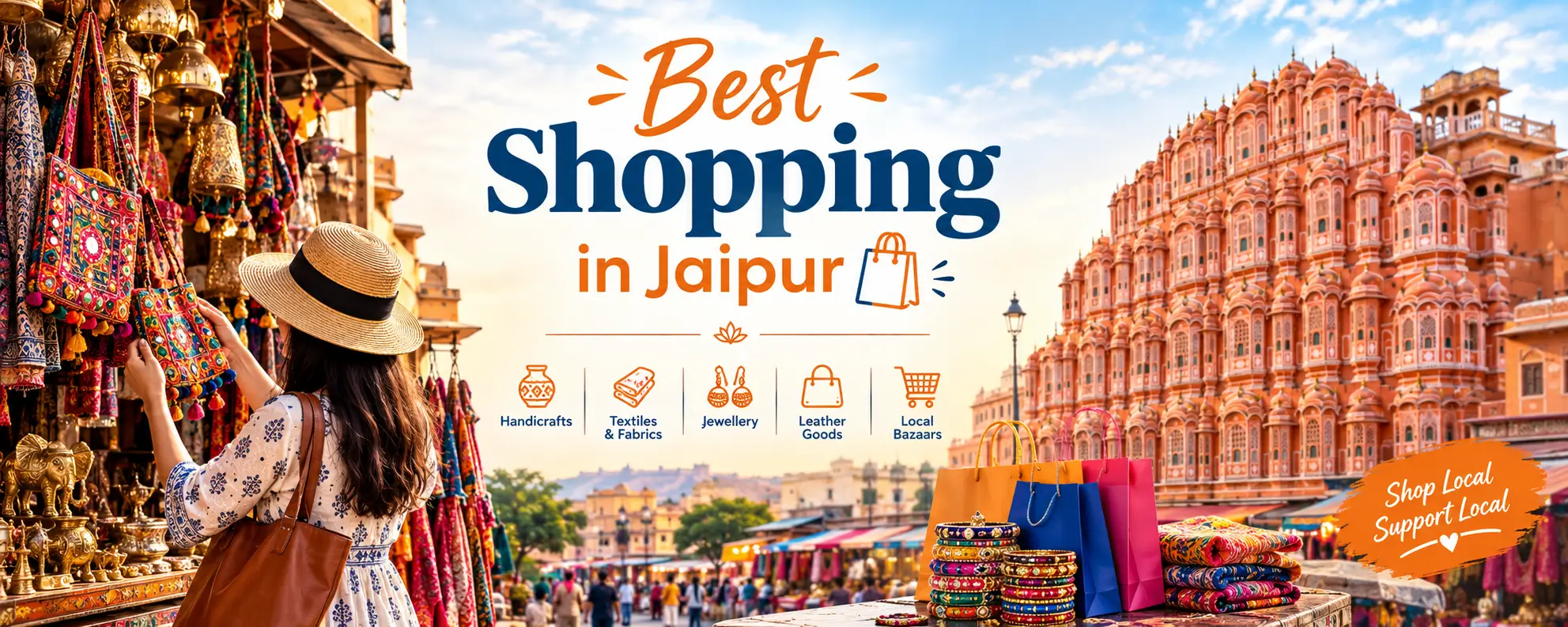
Best Shopping in Jaipur
Shopping in Jaipur is an experience in itself. The Pink City is renowned for its colourful bazaars, traditional handicrafts, jewellery, textiles, block-printed fabrics, blue pottery, leather footwear and distinctive Rajasthani souvenirs. For travellers, Jaipur Shopping is not simply about purchasing products; it is an opportunity to experience the city’s centuries-old commercial and artistic traditions.
The historic markets of Jaipur were an important part of the city’s original urban planning, and many continue to serve as lively commercial centres today. From the jewellery lanes of Johari Bazaar and the textile shops around Bapu Bazaar to the traditional markets around Badi Chaupar and Choti Chaupar, tourists can discover a wide variety of products representing Rajasthan’s craftsmanship. Rajasthan Tourism specifically identifies Johari Bazaar, Bapu Bazaar, Nehru Bazaar, MI Road and the areas around Badi and Choti Chaupar among Jaipur’s important shopping destinations.
Enquiry Form
For visitors interested in Shopping Tourism, Jaipur offers an especially diverse experience. You can shop for a colourful block-printed bedsheet, a lightweight Jaipur blanket, traditional juttis, lac bangles, blue pottery, Rajasthani textiles, handicrafts or fine jewellery and take home something that reflects the artistic character of Rajasthan.
Why Shopping in Jaipur Is an Important Part of Tourism
Shopping has always been closely connected with Jaipur’s identity. When Maharaja Sawai Jai Singh II established Jaipur in 1727, the city was planned with organised commercial areas, markets and streets for different activities. The historic walled city continues to retain this relationship between architecture, commerce and craftsmanship.
Today, Jaipur Shopping gives visitors an opportunity to see traditional crafts alongside modern retail. The city’s markets are particularly attractive because many shopping areas are located close to important heritage landmarks. A sightseeing visit to Hawa Mahal, City Palace or Jantar Mantar can therefore be combined with an exploration of the surrounding bazaars.
The range of products is equally impressive. Jaipur is particularly associated with gemstones and jewellery, blue pottery, textiles, block printing, quilts, handicrafts, lac bangles and traditional footwear. Shopping therefore becomes an extension of the cultural experience rather than a separate activity.
Best Markets for Shopping in Jaipur
Jaipur has several distinctive shopping areas, and each market is known for different types of products. Rather than looking for one single “best market,” tourists can choose markets according to what they want to purchase.
Johari Bazaar – Best Market for Jewellery in Jaipur
Johari Bazaar is one of the most famous shopping destinations in Jaipur and is particularly associated with jewellery and gemstones. The name itself is connected with jewellers, and the market has long been associated with Jaipur’s jewellery-making traditions.
Travellers can find traditional and contemporary jewellery, including pieces inspired by Kundan and Meenakari techniques. Jaipur is also an important centre for gemstone cutting and processing, making the city particularly significant for jewellery shopping.
Johari Bazaar is an excellent destination for visitors looking for jewellery, colourful traditional accessories and bridal ornaments. If you are considering purchasing valuable gemstones or precious jewellery, ask for proper documentation, understand the material and workmanship, and compare products before making a purchase.
Best for: Jewellery, gemstones, Kundan work, Meenakari jewellery and traditional ornaments.
Bapu Bazaar – Best for Textiles, Mojaris and Souvenirs
Bapu Bazaar is one of the most popular markets for tourists looking for a broad selection of affordable Rajasthani products. The market is particularly useful for visitors who want to purchase several souvenirs during the same shopping outing.
You can explore shops selling Jaipuri textiles, block-printed clothing, scarves, traditional footwear, bags, handicrafts and souvenirs. Colourful fabrics and Rajasthani-style designs make the market particularly attractive for travellers.
Traditional mojaris and juttis are among the popular products associated with shopping in this part of Jaipur. Visitors can also find decorative items and gifts that are easy to carry home.
Best for: Clothing, block prints, juttis, mojaris, bags, handicrafts and souvenirs.
Nehru Bazaar – Colourful Rajasthani Shopping
Nehru Bazaar is another well-known shopping area in Jaipur and is popular for its colourful range of traditional products. Its location in the old city makes it convenient to combine with other heritage and shopping destinations.
The market is particularly suitable for tourists searching for traditional clothing, footwear, accessories, handicrafts and souvenirs. Colourful fabrics, embroidered products and Rajasthani-style merchandise are commonly available.
One of the attractions of shopping here is the variety. Travellers who do not have one specific product in mind can browse several categories and find gifts for family and friends.
Best for: Traditional clothing, footwear, accessories, souvenirs and handicrafts.
Tripolia Bazaar – Traditional Crafts and Rajasthani Products
Tripolia Bazaar is located in the historic Pink City and forms part of Jaipur’s traditional commercial landscape. The market and its surrounding lanes offer a more local bazaar experience compared with modern shopping centres.
The area is associated with traditional handicrafts, lac bangles, metalware, textiles and other products. Its location between important parts of the old city also makes it convenient to combine with sightseeing around Badi Chaupar and the Hawa Mahal area.
For travellers interested in experiencing the atmosphere of an old Jaipur market, Tripolia Bazaar is worth exploring.
Best for: Lac bangles, handicrafts, traditional items, textiles and local shopping.
Badi Chaupar and Choti Chaupar – Traditional Market Experience
Badi Chaupar and Choti Chaupar are important public spaces in Jaipur’s historic walled city and are surrounded by traditional commercial areas. These locations are particularly interesting for visitors who want to experience Jaipur’s old-city atmosphere.
The surrounding shops and lanes offer a variety of products, including textiles, handicrafts, souvenirs, traditional clothing and decorative items. Their central location means tourists can easily incorporate these markets into a heritage walk through the old city.
The combination of historic architecture and traditional commerce makes this area particularly valuable from a Shopping Tourism perspective.
Best for: Handicrafts, souvenirs, textiles and experiencing traditional Jaipur markets.
MI Road – Shopping Beyond the Traditional Bazaars
MI Road provides a different shopping experience from the narrow traditional bazaars of the old city. It includes established shops, showrooms, handicraft outlets and businesses offering a wider range of traditional and contemporary products.
Rajasthan Tourism also lists MI Road among Jaipur’s important shopping destinations. Travellers looking for handicrafts, textiles, jewellery and Rajasthan-themed products can consider this area when they want a more organised shopping environment.
It can also be useful for visitors who prefer to compare traditional handicrafts with more contemporary retail products.
Best for: Handicrafts, textiles, jewellery, souvenirs and organised shopping.
Things to Buy in Jaipur
The most enjoyable part of Jaipur Shopping is deciding what to take home. The city offers products ranging from small souvenirs to valuable jewellery and large home furnishings.
Here are some of the most popular things to buy in Jaipur.
Jaipur Bedsheets – One of the Most Popular Things to Buy
Jaipur bedsheets are among the most popular textile purchases for visitors. They are particularly appreciated for their colourful patterns, floral motifs and traditional printing styles.
You can find bedsheets featuring Sanganeri and Bagru-inspired designs, block prints, floral patterns, geometric motifs and contemporary interpretations of traditional Rajasthani textiles.
Bedsheets are available in different fabrics, sizes, colours and designs. Before purchasing, check the fabric composition, dimensions, print quality and colour fastness, especially if you are buying several pieces.
For tourists looking for something practical that also reminds them of Rajasthan after returning home, a Jaipur bedsheet is one of the most useful souvenirs to consider.
Jaipur Blankets and Jaipuri Razai
A Jaipur blanket or traditional Jaipuri razai can be another excellent purchase for travellers interested in Rajasthani textiles.
Jaipuri quilts are traditionally known for being lightweight while providing warmth, making them particularly different from heavy winter blankets. They are often available in colourful printed cotton fabrics and can feature traditional block-print patterns.
When shopping for a Jaipur blanket or razai, pay attention to the filling, outer fabric, stitching and overall weight. Since products can differ considerably, comparing several pieces before purchasing can help you understand the differences in quality.
These textiles are particularly popular because they combine functionality with the visual appeal of traditional Jaipur craftsmanship.
Blue Pottery – A Signature Jaipur Handicraft
Jaipur blue pottery is one of the city’s most distinctive crafts and a popular souvenir among domestic and international visitors.
Unlike conventional pottery that is primarily made from clay, traditional Jaipur blue pottery uses a quartz-based composition. Characteristic blue and turquoise colours are combined with floral, geometric, bird and animal motifs.
Visitors can find blue pottery in the form of plates, bowls, vases, trays, coasters, tiles, decorative objects and other household products.
Because many pieces are delicate, tourists purchasing blue pottery should consider how they will safely transport it home. Smaller pieces may be more convenient for air travel, while larger decorative pieces may require careful packaging.
Block-Printed Textiles
Block printing is one of the most recognisable textile traditions associated with the Jaipur region. Sanganer is particularly known for Sanganeri printing, while Bagru is another important centre of traditional block printing.
Wooden blocks are used to apply designs to fabric, creating distinctive repeated patterns. Floral motifs are particularly associated with Sanganeri textiles, while Bagru traditions are known for their own characteristic printing techniques and earthy colour palettes.
Visitors can purchase block-printed kurtas, dresses, scarves, dupattas, shirts, bedsheets, table covers, cushion covers and fabrics.
For travellers interested in authentic handicrafts, visiting textile areas around Jaipur and Sanganer can provide a deeper understanding of how these fabrics are produced.
Kundan and Meenakari Jewellery
Jaipur is particularly famous for traditional jewellery, and Kundan and Meenakari are two names that frequently appear when discussing the city’s jewellery heritage.
Kundan jewellery is associated with the setting of gemstones in a refined jewellery structure, while Meenakari involves colourful enamel decoration. These traditions have strong connections with Rajasthan’s royal and artisanal heritage.
Jewellery shopping requires more consideration than purchasing ordinary souvenirs. If you are buying precious metals or gemstones, ask for appropriate documentation and understand exactly what you are purchasing.
For visitors who want a lasting reminder of Jaipur’s royal aesthetic, traditional jewellery can be one of the most distinctive purchases from the city.
Lac Bangles
Colourful lac bangles are another traditional Rajasthani product worth looking for while shopping in Jaipur. Lac is a natural resin that can be shaped and decorated to create vibrant bangles and ornaments.
Bangles may be decorated with beads, stones, mirrors and other embellishments, resulting in colourful combinations suitable for traditional and festive clothing.
They are lightweight, easy to carry and relatively simple to pack, making them convenient souvenirs for tourists.
Mojaris and Juttis
Traditional Jaipur juttis and Rajasthani mojaris are popular footwear choices for visitors. They are available in a variety of colours, embroidery patterns and designs.
Some feature detailed threadwork and decorative elements, while others have simpler designs suitable for everyday wear.
When buying footwear, it is worth trying different sizes and checking the stitching and comfort rather than choosing purely on appearance.
Handicrafts and Rajasthani Home Décor
Jaipur’s markets offer a wide selection of decorative handicrafts that can bring a Rajasthani character into the home.
Depending on the market and shop, visitors can find wooden décor, metalware, decorative boxes, pottery, textiles, wall hangings, carved items and other traditional products.
These products are particularly suitable for tourists who want souvenirs beyond clothing and jewellery. Smaller decorative pieces are also easier to transport.
Carpets and Dhurries
Carpets and dhurries are another important category within Rajasthan’s craft traditions. They can add colour and traditional patterns to homes and are available in different sizes, materials and designs.
If you are considering purchasing a carpet or dhurrie, examine the material, weave, dimensions and finishing carefully. Because larger pieces can be difficult to carry during travel, ask the seller about appropriate packaging and transportation options where necessary.
Best Places to Buy Handicrafts in Jaipur
Travellers looking specifically for handicrafts have several options across Jaipur. Traditional bazaars such as Bapu Bazaar, Nehru Bazaar, Tripolia Bazaar and the areas around Badi and Choti Chaupar provide a wide selection.
For visitors who prefer a more structured shopping environment, Rajasthali, the Rajasthan Government handicraft emporium on MI Road, is another recognised option. It can be useful for tourists who want to explore a government-emporium setting rather than relying exclusively on street markets.
Visitors interested specifically in textiles and block printing can also explore Sanganer, where textile printing is an important part of the area’s craft tradition.
The right choice depends on what you want to buy: traditional bazaars are ideal for browsing a wide variety of products, while specialist and government-supported outlets can be useful when you want more focused shopping.
Best Market to Buy Jaipur Bedsheets
If your primary purpose is to purchase Jaipur bedsheets, Bapu Bazaar and other traditional textile markets in the old city are useful places to start. You can also explore shops specialising in block-printed fabrics and visit Sanganer if you want to understand the printing tradition more closely.
When buying bedsheets, do not judge quality solely by colour or design. Check the fabric, stitching, print clarity, dimensions and whether the pattern is block printed or produced through another printing process.
Since Jaipur bedsheets are available in many qualities and price ranges, comparing multiple products before purchasing is worthwhile.
Best Market to Buy Jaipur Blankets and Razai
For Jaipur blankets, quilts and Jaipuri razai, tourists can explore textile shops in Bapu Bazaar, Nehru Bazaar and other established shopping areas. Specialist textile stores can also provide a broader range of fabrics, fillings and designs.
Look carefully at the weight, filling, stitching and fabric when choosing a razai. A lightweight quilt may be more convenient for travellers who want something easy to transport, while larger blankets may require additional luggage space.
Traditional printed quilts are especially popular because they combine the practicality of home textiles with Jaipur’s colourful design traditions.
Shopping Tourism in Jaipur- More Than Buying Souvenirs
Shopping Tourism has an important place in Jaipur because the city’s markets are closely connected with its history, crafts and social life.
A visit to Johari Bazaar reveals Jaipur’s jewellery tradition. Bapu Bazaar introduces visitors to colourful textiles, footwear and souvenirs. Tripolia Bazaar offers another perspective on traditional handicrafts, while Sanganer provides a connection to the region’s textile-printing heritage.
This makes shopping an important cultural activity rather than simply a commercial one. Travellers can see traditional designs; understand how local products are used and take-home objects that have a connection with Rajasthan’s artistic heritage.
Tips for a Better Jaipur Shopping Experience
Compare Before You Buy
Jaipur has many shops selling similar categories of products. Comparing quality, materials, workmanship and prices can help you make a more informed decision.
Check Textile Quality
For bedsheets, blankets, quilts and clothing, check the fabric composition, stitching, dimensions and printing quality.
Be Careful With Precious Jewellery
If you are buying gemstones, gold, silver or expensive jewellery, request appropriate documentation and understand the product’s specifications before purchasing.
Pack Fragile Handicrafts Carefully
Blue pottery, glass, ceramics and certain decorative objects can break easily. Ask for suitable protective packaging if you are carrying them on a flight.
Ask About the Craft
One of the best ways to make shopping more meaningful is to ask about how an item was made. Understanding the printing, weaving, carving or decoration process can help you appreciate the product beyond its appearance.
Carry Extra Luggage Space
Jaipur shopping has a way of adding to your luggage. Bedsheets, quilts, clothing, handicrafts and souvenirs can quickly take up more space than expected, so keep your luggage capacity in mind.
Plan Your Jaipur Trip — More Guides
Handpicked reads from Travfolks Holidays to help you shape the perfect Jaipur holiday.
- Travel Guide Jaipur Tourism Attractions, cuisine, shopping & royal charm
- Travel Guide Top 15 Tourist Attractions in Jaipur Amer Fort, Hawa Mahal, City Palace & Jantar Mantar
Frequently Asked Questions About Shopping in Jaipur
Jaipur is particularly famous for jewellery, gemstones, Kundan and Meenakari work, blue pottery, block-printed textiles, Jaipuri bedsheets, quilts and razai, lac bangles, traditional juttis and Rajasthani handicrafts.
There is no single best market for every product. Johari Bazaar is particularly associated with jewellery, while Bapu Bazaar is popular for textiles, footwear and souvenirs. Nehru Bazaar, Tripolia Bazaar, MI Road and the markets around Badi and Choti Chaupar offer different combinations of handicrafts and traditional products.
Bapu Bazaar and other textile markets in Jaipur are popular places to look for Jaipur bedsheets and block-printed fabrics. Travellers interested in understanding the printing tradition can also explore Sanganer, an important textile-printing area near Jaipur.
Jaipur blankets and Jaipuri razai can be found in textile shops and traditional markets including Bapu Bazaar, Nehru Bazaar and other established shopping areas. Compare the filling, fabric, stitching, weight and dimensions before choosing one.
Popular Jaipur handicrafts include blue pottery, block-printed textiles, lac bangles, traditional footwear, wooden and metal decorative items, quilts, dhurries and Rajasthani home décor. The best choice depends on whether you want something decorative, practical or easy to transport.
Johari Bazaar is one of Jaipur’s best-known jewellery markets and is particularly associated with gemstones, traditional jewellery, Kundan and Meenakari work. For expensive jewellery or gemstones, buyers should carefully check authenticity, specifications and documentation.
Good souvenirs include blue pottery, block-printed scarves, textiles, Jaipur bedsheets, small handicrafts, lac bangles, traditional juttis, miniature decorative items and Rajasthani handicrafts. Choose smaller and more durable products if you have limited luggage space.
Bargaining can be part of the shopping experience in many traditional markets, particularly where products do not have fixed prices. However, the approach can vary from one shop and product category to another. For expensive jewellery, handicrafts or branded products, focus on the product’s quality, authenticity and documentation rather than price alone.
Jaipur blue pottery is distinctive because its traditional composition is quartz-based rather than conventional clay. It is recognised for blue and turquoise colours and decorative floral, geometric, bird and animal motifs. The craft has become one of the signature handicrafts associated with Jaipur.
Shopping provides visitors with an opportunity to experience Jaipur’s living craft traditions, traditional markets and artistic heritage. Jewellery, textiles, pottery, handicrafts and footwear are not simply souvenirs; many reflect techniques and traditions that have developed over generations.
Experience Shopping in Jaipur with Travfolks Holidays
At Travfolks Holidays, we believe that discovering Jaipur means experiencing more than its magnificent forts and palaces. The city’s markets, crafts, textiles, jewellery and traditional products reveal another important side of Rajasthan’s cultural identity.
During your Jaipur journey, you can explore the colourful bazaars of the Pink City and look for Jaipur bedsheets, Jaipur blankets, Jaipuri razai, block-printed textiles, blue pottery, jewellery, handicrafts, juttis, lac bangles and other traditional souvenirs.
Our Jaipur Tour Packages can be combined with wider Rajasthan journeys, allowing travellers to experience the heritage and shopping traditions of destinations beyond Jaipur as well. Whether you are visiting as a family, couple, group or individual traveller, we help you experience Jaipur’s attractions while leaving time to discover its vibrant shopping culture.
From the jewellery lanes of Johari Bazaar to the colourful textiles of Bapu Bazaar and the craft traditions associated with Sanganer, Jaipur Shopping is an essential part of experiencing the Pink City.
Travel with Travfolks Holidays and take home not just memories of Jaipur, but a piece of Rajasthan’s colourful artistic heritage.
Testimonials
Posted onTrustindex verifies that the original source of the review is Google. Had a wonderful experience with Travfolks Holidays! Everything was well-planned, smooth, and stress-free. Truly made our trip to Vietnam memorable. Highly recommend. Additional thanks to Mr. Pallab Bhuyan for taking all the hardship and arranging the trip. Thank you Pallan and Thanks to all the staff of Travfolks Holidays...keep it up!Posted onTrustindex verifies that the original source of the review is Google. TravFolks Holidays is one of the Best Travel Company in India. I am getting the Service from last 1.2 Years for all my Company needs as well as for my personal requirements. There Service is very Prompt and cheaper from the existing Market. All the office Staff is very active and has positive approach towards their business and commitments. Kindly keep these prompt services continue.... We wish you very all the best for your future business ...Posted onTrustindex verifies that the original source of the review is Google. Our both foreign and.domedtic tours were taken through travfolks holidays.In last part of 2023 our tour was to Phuket and Krabi Island of Thailand which the agency has managed smoothly and we faced no problem.For this we are thankful to proprietor of this agency Mr. Bhuyan. Domestic holiday tour to Goa was also arranged very smoothly by him.In short I can recommend everyone to avail tour programme through this agency.Posted onTrustindex verifies that the original source of the review is Google. TravFolks Holidays Best Travel Agency in Guwahati. Very good response and service quality fully satisfied👍Posted onTrustindex verifies that the original source of the review is Google. Wonderful service and support! Special thanks to Pallab Bhuyan 👍Posted onTrustindex verifies that the original source of the review is Google. Great service quality, would definitely recommend.Posted onTrustindex verifies that the original source of the review is Google. Excellent..! One stop solution for all tour and travel related services, they really provide good domestic and international holiday packages, hotels,air/train tickets etc. Will definitely recommend..👍Verified by TrustindexTrustindex verified badge is the Universal Symbol of Trust. Only the greatest companies can get the verified badge who has a review score above 4.5, based on customer reviews over the past 12 months. Read more